Thursday, 21 April 2016

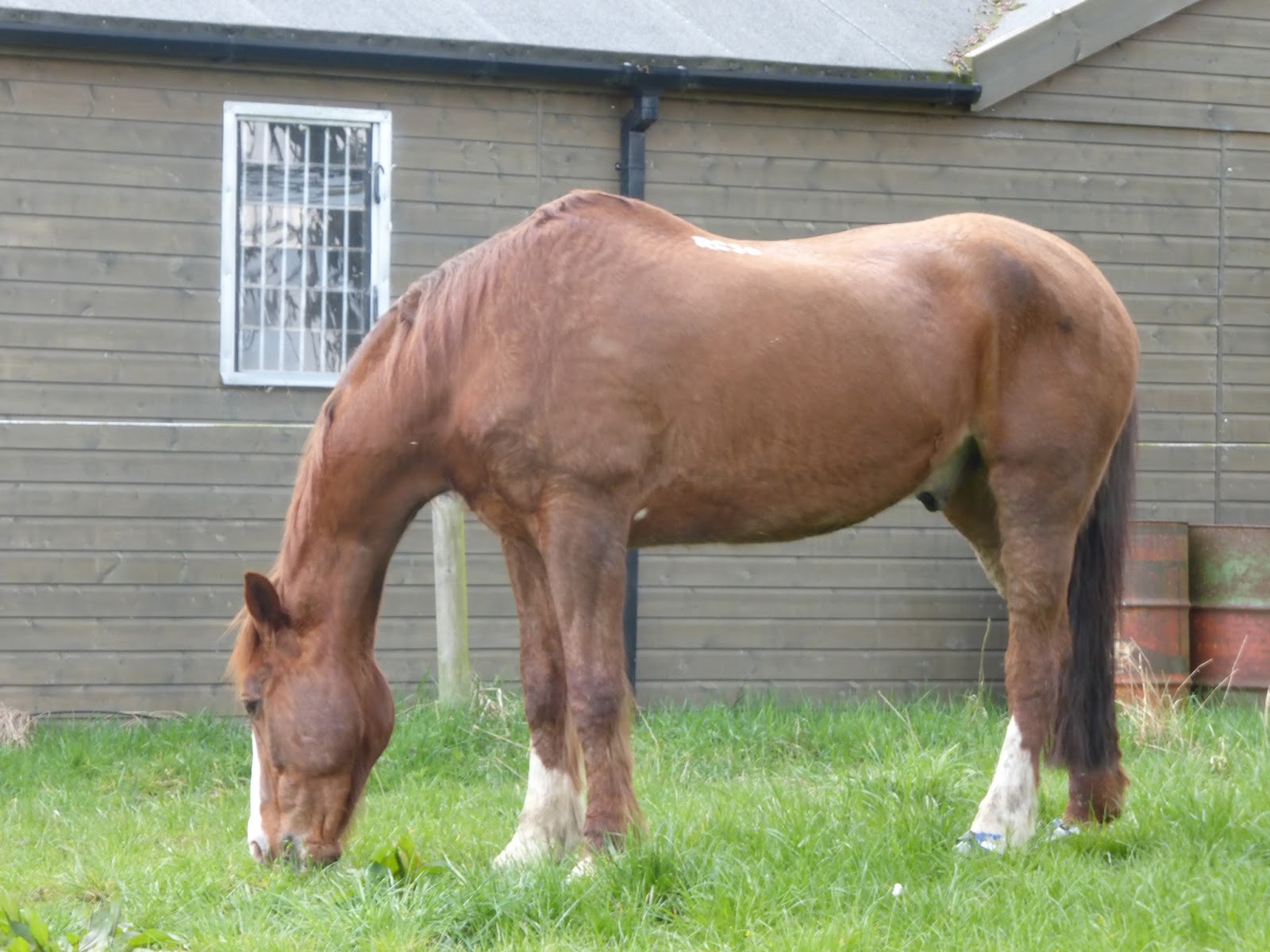
Tommy Update - 9 months!


If you watch my videos on You Tube you will have seen yesterday that I have been working towards catching Tommy in the field!  When I first met him at the Blue Cross they were just making progress with getting close enough to catch him in the field, with a headcollar on.  He was still very nervous and it was a slow, gentle approach.  

 
As expected he was unsettled when he moved to us and went backwards with some aspects of his confidence.  None was more noticeable than in the field.  Tommy was always more confident in the stable at the Blue Cross and this carried through when we got him home.  I used this to continue his learning with removing and putting on a headcollar, brushing, having his feet picked out and even a rug on.  He has made HUGE leaps with this :)


Unfortunately, his confidence in the field has been much slower to recover and improve.  Initially I kept his headcollar on at home too, but on wet days it began to rub, so I had to take it off.  I am lucky because I don’t need to catch him to get him in.  He quickly learnt that (in the summer) he came into the stable in the morning for a snack, rest and some hay by following Chesney and Basil in.  This meant that we could continue with building confidence in the stable with no worries.  Getting up to Tommy in the field was much more difficult.  That has taken a long time, sometimes I could get him to eat a quarter of apple out of my outstretched hand, sometimes I couldn’t even get that close.  I could not get close enough to touch him at all.  


Once I changed them to being in at night and out in the day (for the winter) he again learnt that by following the others in he had a little feed.  I gradually found that I could get closer to him in the field without him running away.  Initially, even if I went to catch Basil or check the fence, if I got within a certain distance he would trot off.  He then progressed to just walking off and I could get closer and closer without him moving away – but I still couldn’t touch him.  Since Christmas I have fenced him in a separate and smaller area (to try to limit his grass) which has allowed me to work on this more.  It was not that long before I managed to get up to him with an apple and stroke his nose, then I could touch his neck and shoulder.  This meant that if he had a headcollar on I could catch him, so I started leaving it on again.  Unfortunately, Tommy then learnt how to get that off in the field. 

This left me with a new challenge.  However, he is in the routine of coming to the gate in the evenings with the others (but in his separate section).  So, if I get Chesney and Basil in first he is quite desperate to come for his food too.  I have been using this, with an apple, to get close to him – see my video. 

Since, I filmed this last week I have managed to get the headcollar on him too :)  He feels more confident close up by the stables so I don’t think I would be able to do this down the field YET but it is progress – which I am really proud of.

Have a look at the video of Tommy yesterday 'Catching Tommy'  on my You Tube channel.   
Horse Life and Love. Please check it out and SUBSCRIBE.

You can also follow me on Facebook and Instagram for updates on Chesney, Basil, Tommy and Daisy.

Until next time!
Jo

Monday, 18 April 2016

Fell Ponies


A couple of weeks ago I wrote a blog about Dales Ponies, the Fell is similar but smaller.  They too are native to the north of England and are mostly found in Cumbria.  They are adaptable to almost any climate because they were bred for the harsh conditions found in Northern England.  


History

The Fell ponies were also originally used as packhorses and would carry various goods from lead to wool.  They could travel considerable distances as they are good and fast walkers.  It is thought that the Vikings also used the ponies for ploughing and riding.  Fell ponies can work all day with little food which made them popular!

In the 19th century the Fell ponies were used for trotting races, light farm work and transporting goods.  In 1918 the Fell pony society was set up but numbers continued to decrease until after World War II.   Fell ponies are ridden and driven by members of the Royal Family and Queen Elizabeth II is their patron.  Unfortunately, they are still listed as 'endangered'.

Today Fell ponies can be found in the USA, Canada, France, Germany, Holland and Switzerland.  


Characteristics

Height: Average 13 hh - 14 hh

Colour:  Black, dark brown, dark bay and occasionally grey.  No or little white markings.

Conformation:  Small, well set head with bright and intelligent eyes.  Strong neck and sloping well developed shoulders. The back is short and strong and the quarters are also strong. Legs are straight with good bone.

Temperament:  Excellent temperament. They are lively and alert but steady and are sure footed.   They are good children's ponies but are strong enough for an adult.  They are popular for driving and although are not the fastest they can be good all rounders. 


The Fell Pony Society Website:  http://www.fellponysociety.org.uk/

Did you see last week's video 'One Day in April'  on my You Tube channel.   
Horse Life and Love.  Please check it out and SUBSCRIBE.

You can also follow me on Facebook and Instagram for updates on Chesney, Basil, Tommy and Daisy.

Until next time!
Jo

Friday, 15 April 2016

All About ... Corns.


What are they?

Corns are basically a bruise on the sole which has formed between the bars and the wall of the hoof.  Labelled ‘seat of corn’ in the diagram below , find out more in my blog.  Corns can be really painful and can easily develop into an abscess.


Signs

These are similar to those for a bruised sole.
  • Sudden lameness, usually only slight, but most often seen in the front feet 
  • A clean sole will often show up the bruise (much easier to see on light coloured soles) 
  • Sensitivity in the area 
  • Increase to digital pulse 
  • Heat in foot (possible)


Causes

  • Badly fitted shoes 
  • Stone becoming wedged between the shoe and the sole


Diagnosis

Once the hoof has been trimmed it is easy to see a corn.  As with a bruise, the hoof testers will provoke a reaction from the horse.  This may be a flinch but some will kick out!  


Treatment

Removal of the shoe will often allow the corn to heal on its own, as this relieves the pressure!  The horse should be rested whilst healing is in progress.  If it has developed into an abscess this will need different treatment – see my blog. Once the corn has healed the horse can have the shoe refitted – taking into consideration the cause of the corn!


Prevention
  • Ensuring shoes are the correct size 
  • Regular visits by the farrier to keep feet and shoes in tip top condition 
  • Avoid rocky, rough ground where possible

Did you see Wednesday's vlog 'One Day in April'  on my You Tube channel.   
Horse Life and Love.  Please check it out and SUBSCRIBE.

You can also follow me on Facebook and Instagram for updates on Chesney, Basil, Tommy and Daisy.

Until next time!
Jo

Thursday, 14 April 2016

Photo Day!


Sunshine - first rugless day of the year :)


I wrapped Chesney's feet up so he didn't miss out!


Tommy has been working on his layer of mud for a few days now!


Have you seen yesterday's vlog 'One Day in April'  on my You Tube channel.   
Horse Life and Love.  Please check it out and SUBSCRIBE.

You can also follow me on Facebook and Instagram for updates on Chesney, Basil, Tommy and Daisy.

Until next time!
Jo