Thursday, 22 September 2016

Last week summer, this week autumn!


I can't believe it was so hot last week, it is suddenly much colder at night:)  Glad the boys are tucked up in their stables now.


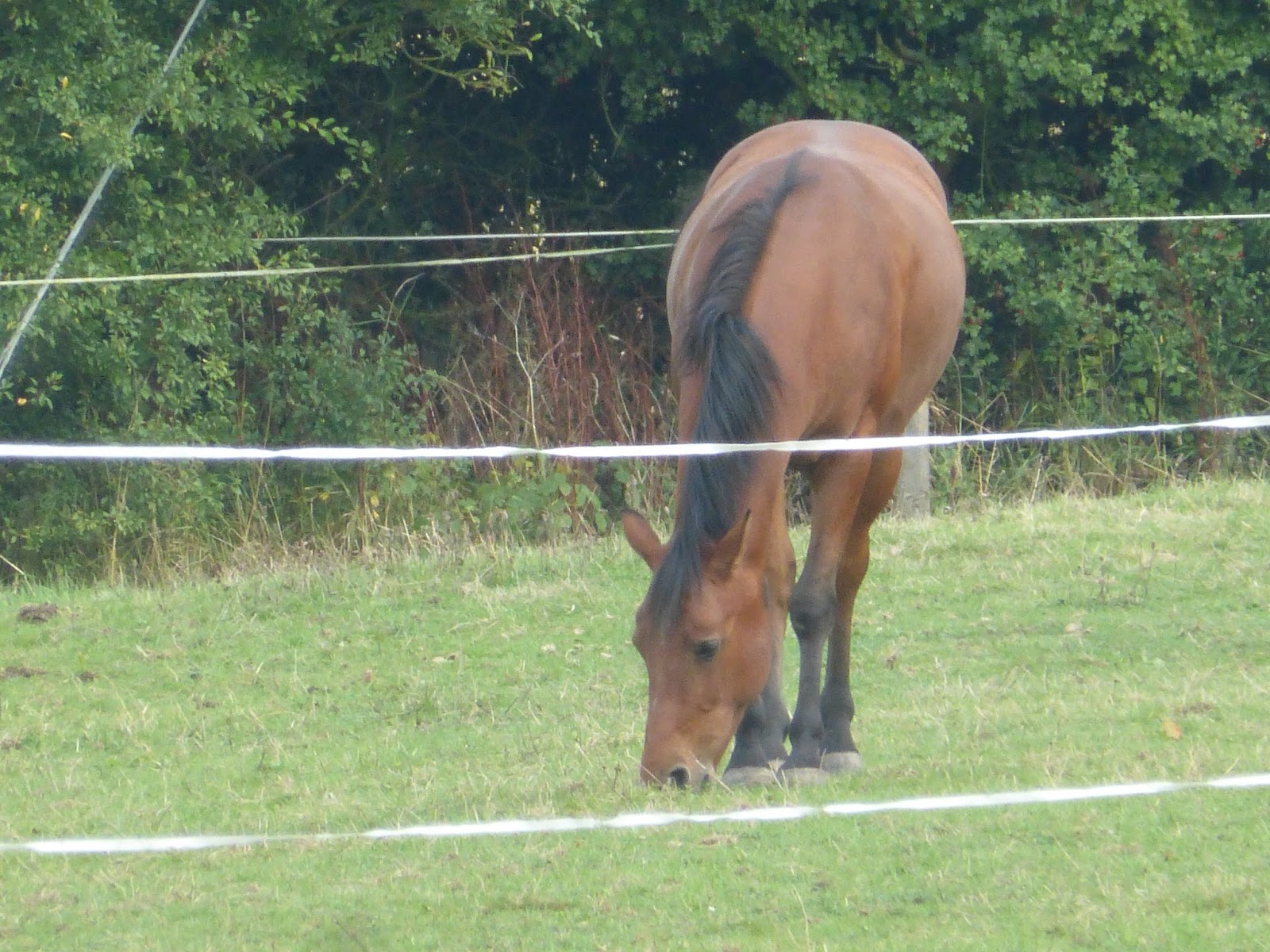
Basil is definitely the biggest fan of the Paddock Lick! 


Have you seen this week's video yet 'Autumn has arrived' on my You Tube channel.   
Horse Life and Love.  Please check it out and SUBSCRIBE.

You can also follow me on Facebook and Instagram for updates on Chesney, Basil, Tommy and Daisy.

Until next time!
Jo

Monday, 19 September 2016

Why don't we eat horses?


This might sound like an odd blog to write considering all my other topics.  I definitely would never knowingly eat horse meat but I have always wondered why it is not something eaten in many other countries around the world or by non-horsey people.


It is not a new thing, people have not eaten horses for many hundreds of years.  Over a thousand years ago the Pope issued an order totally prohibiting the eating of horse meat. 

One of the first blogs I wrote 2 years ago was about the history of the horse.  Horses were eaten by our early ancestors of the Ice Age, when their method of hunting was to make herds of wild horses panic and fall over the edge of a cliff.  During the Stone Age herds were rounded up instead and used for meat, milk, their tough hides and their bones for implements.  However, they also used horses to carry and transport themselves and belongings.  Horses allowed our ancestors to travel much greater distances and gradually became the most important animal to man.

Legends began to form around horses until they were thought of as sacred.  The horse was fit for the gods, it carried them through the skies thus explaining thunder and lightning - hooves and whips!  Horses then became sacrificial animals for early Pagan rituals.  The believers gained strength from eating horse meat and drinking blood. 

The beginning of Christianity meant stamping out the old Pagan religion and rituals - thus eating horse meat became wicked and dirty.  This was when the Pope forbade the eating of horse meat.   Although Pagan horse eating continued in some areas it did stop eventually throughout most of the Christian world.   Many other religions also prohibit the eating of horse meat.

 
During the 1800's when many of the poorer classes were malnourished and starving it was suggested that horses, once they came to the end of their working lives, would be a good addition to the diet.  Beef prices were high due to widespread epidemics killing cattle in their thousands but there were many horses.  In France and Belgium many people did accept the idea - and they still eat horse meat today.  However, most countries did not because the horse was now thought of differently, partly thanks to Charles Darwin. 

Darwin had shown that humans were related to other species and many people began to feel a greater bond to animals.  Welfare organisations were beginning to appear with opposition to animal cruelty and vegetarianism was becoming more popular. 

The horsemeat scandal in 2013 when traces of horse meat were found in supposed beef and pork products demonstrated how strong public feeling still is.

So, in our modern world few people will eat horse meat. Although, many of us for the simple reason that the horse gives us so much, why would we want to eat them!

 
 Have you seen last week's video 'Big Autumn Clear Out - Day 1' on my You Tube channel.   
Horse Life and Love.  Please check it out and SUBSCRIBE.

You can also follow me on Facebook and Instagram for updates on Chesney, Basil, Tommy and Daisy. 

Until next time!

Jo

Friday, 16 September 2016

All About ... Recurrent Uveitis

What is it

Recurrent Uveitis, Moon blindness or Periodic Ophthalmia is the most common condition occurring inside the eyeball of horses.  It is most often seen in horses 3 - 7 years old.  The condition can clear up and improve only to recur a few months later but it often eventually causes permanent blindness. 


Signs

  • Tears running down the cheeks 
  • Sensitivity to light 
  • Closing or swollen eyelids 
  • Conjunctivitis 
  • Occasionally the pupil won't dilate 
  • May be pus in anterior chamber of the eye


Causes

It is not certain what causes Recurrent Uveitis, suggestions include:

  • Viral Infection 
  • Bacterial Infection 
  • Parasitic Infection 
  • Auto- immune disease 
  • Trauma


Diagnosis

Call the vet.  They will perform  a clinical examination of the eye initially, this with known history of the horse may lead to a diagnosis. 


Treatment

Treatment during the first episode is critical to limit the damage caused to the eye.  The treatment may include corticosteroids given as eye drops which will reduce the inflammation.  Unfortunately these can also slow the healing process .  Non-steroidal medications may also be given and Atropine eye drops will help to reduce the inflammation.


Prevention

Ensure your horse receives a balanced diet to ensure they are in the best possible health.  Prevent trauma to the eye by using eye masks, feeding from the ground and checking fields and stables for any protruding objects which could cause trauma.


Did you see this week's video 'Big Autumn Clear Out - Day 1' on my You Tube channel.   
Horse Life and Love.  Please check it out and SUBSCRIBE.

You can also follow me on Facebook and Instagram for updates on Chesney, Basil, Tommy and Daisy.

Until next time!
Jo

Summer is back!


A hot week again, hundreds of nasty flies too :(


Tommy did manage an early morning nap though!


Have you seen yesterday's video 'Big Autumn Clear Out - Day 1' on my You Tube channel.   
Horse Life and Love.  Please check it out and SUBSCRIBE.

You can also follow me on Facebook and Instagram for updates on Chesney, Basil, Tommy and Daisy.

Until next time!
Jo

Monday, 12 September 2016

Hanoverian Horses


The Hanoverian was originally developed by combining the blood of Spanish, Neapolitan and Oriental stallions with native mares.  They are one of the oldest Warmbloods.
 

History

During the 1700's Holstein stallions were crossed with Holstein, Neapolitan and Andalucian mares.  Later the same century thoroughbred blood was added with the result being a lighter horse which still had plenty of strength and endurance.  The aim was to breed a horse for military service  but also with the strength needed for farm work.    

The breed was threatened during the Napoleonic Wars.  To help restore the population, more thoroughbred blood was added.  This gave the Hanoverian more 'quality' and they were increasingly used as carriage horses towards the end of the 1800's and the beginning of the 20th century.

The reduction in the role of the horse in agriculture after World War II meant that the breeding began to move towards producing competition horses.  Some Trakehner blood was introduced along with more Thoroughbred blood.  Super Nova II ridden by Spencer Wilton is one of the top dressage horses in the UK.


Today Hanoverian's are found all over the world.  There are 450 approved stallions and almost 19,000 brood mares. 


Characteristics

Height: 15.3hh - 16.2hh

Colour: Any solid colour, but usually chestnut, bay, black or brown.

Conformation:  Fairly plain head, long neck.  Large and sloping shoulders with a deep girth and powerful quarters.  Well- muscled legs with good, hard feet.

Temperament: Well mannered and easy to handle.

Used for showjumping, dressage and eventing.


The British Havoverian Horse Society Website: http://hanoverian-gb.org.uk/drupal/

Did you see last week's video 'Steaming or Soaking Hay' on my You Tube channel.   
Horse Life and Love. Please check it out and SUBSCRIBE.

You can also follow me on Facebook and Instagram for updates on Chesney, Basil, Tommy and Daisy.

Until next time!
Jo

Friday, 9 September 2016

All About ... Rainscald


What is it

Rainscald is a skin irritation which some horses develop when exposed to the environment.  It is caused by the same organism which causes mud fever.  


Signs

The hair on the horses back and croup becomes matted and an inflammatory liquid oozes from the skin.  The hair may fall out in clumps and often leaves a raw, bleeding surface.


Causes

Long periods of rain causing an irritation of the skin - usually on the back and croup because these areas are flat and take most of the rain when it falls.


Diagnosis

Scabs are taken and observed through a microscope to identify the bacteria. 


Treatment

Rainscald will heal on its own, however, future prevention is advisable.  In the worst cases treatment involves gently removing the loose hair.  The area should then be washed with a mild shampoo and warm water.  This will help soften the scabs and some may lift away.  The horse should then be dried thoroughly. 

Once the coat is dry the horse can be gently brushed with a soft body brush.  Finally, apply an appropriate cream to any exposed skin - this will help keep it moist and supple.  Massage this into the area which will also help stimulate the horses circulation.

As with mud fever this will need reapplying regularly.  As scabs become loose they can be removed being careful not to make the area bleed.  Once the scabs have gone the hair will be able to regrow.


Prevention

Protection from the elements.  A stable or field shelter for the worst weather, for some horses a turnout rug will be necessary.  


Have you seen Wednesday's video 'Steaming or Soaking Hay'  on my You Tube channel.  
Horse Life and Love.  Please check it out and SUBSCRIBE.

You can also follow me on Facebook and Instagram for updates on Chesney, Basil, Tommy and Daisy.

Until next time!
Jo

Thursday, 8 September 2016

Review August 2016


Getting back on track this month :)  Basil has been sound and we have been making some progress.  I am glad that we have nearly managed to carry on where we left June.  I was concerned we would be straight back to square one but he is working nicely.  I had a riding lesson in the middle of August and it is amazing how after that everything gets even better!  It is good just to be nudged out of any bad habits,  I am hoping to have a few regular lessons again from now on - if I can fit them in.
 

My aims for August with Basil were: 

1.       Calmness - I think we are making progress in all paces
2.       Rhythm - good trot rhythm and canter is getting better
3.       Suppleness - Basil is looking for a contact now in trot
4.       Consistency of bend on left rein - this, I think, is always going to be a challenge
5.       Having more consistent contact - getting there!
6.       Right canter lead - no problems this month
7.       Trot serpentines are getting more balanced on both reins
8.       Improve our canter - definite improvements being made
9.       Leg yield in walk  - good although I have to be careful Basil doesn't try to do this too fast and 'fall' through his shoulder.  
10.   New exercises  - fail!

This is what August  looked like:

2nd - Lunged today, very silly - still excited to be doing something after his time off.  Supposed to be mostly walk and a little trot.

4th - Farrier came today to put his back shoes back on - we can start work proper again.

5th - Lunged again .... improving!

6th - Arena - First time I have ridden for quite a long time so mostly walk.  We just did 20 minutes today with a little trot on each rein.  Lots of circles and changes of rein working on getting the correct bend.

7th - Rode in the arena again today  for a little bit longer.  It was quite windy so Basil took the opportunity to find the corner of the arena very scary.  He was more keen today too but still pleased with him.  Much the same as yesterday.  

9th - Lunging again - Basil was a good boy today.    

10th - Rode in the arena for 25 minutes this morning - again lots of circles and rein changes and serpentines in walk and we are increasing time spent trotting.

12th - Good lunging session again.   

13th - Rode in the arena 30 minutes- silly today and kept shying for no reason!   


14th - 30 minutes in the arena again - such a monster!  Basil was worse today and would not go up to the far end of the arena.  We ended up working in the 3/4 nearest the gateway in walk and trot.  Had a little canter too!  By the end I did manage to get him to walk around the far end on each rein.  

16th - Lunged today - getting better and more settled again now :)

17th - 30 minutes in the arena and although he is getting a bit better he still made a big deal out of the corner.  More trotting today.  Walk leg yield.

19th - Lunged arena again.  He had 1 silly moment but on the whole is being pretty sensible to lunge again now.   

20th - Too windy today.

21st - Arena.  Basil was good considering it was still quite windy.  He was on his toes and a bit jumpy but did some nice work in walk and trot on the bit (in between the jumping and shying).  More walk leg yield and walking over a pole.

22nd - lunged - definitely improving.

23rd - Arena again - definitely improving.  I feel like we have mostly carried on where we left off in June.  Cantering is not as mad as it was in early June and he is still looking for a contact. 

26th - Lunged.

27th -  Hack today - so good getting out again, Chesney was not very impressed though.  Basil was very good and sensible even on the way home!

29th - Arena and Basil was good on the whole.  We had a bit of an interruption when the point to pointers went past and Tommy decided to gallop up and down and Chesney joined in.  Basil though had his sensible head on (unusually) and was happy to carry on, we did some 10m circles in walk whilst they went past and then carried on normally.  We did some really nice work in trot today and had 2 sensible canters.  

30th - Lunged this morning, it was cold :(

I am hoping September will be a good month now we are getting back on track!

1.          Calmness - especially in canter
2.          Rhythm 
3.          Suppleness 
4.          Consistency of bend on left rein 
5.          Having more consistent contact
6.          Some work on the bit
7.          Trot serpentines still need to be more balanced
8.          Improve our canter, less rushed
9.          Some new exercises
10.      Trotting poles

  
Did you see yesterday's video 'Steaming or Soaking Hay'  on my You Tube channel.   
Horse Life and Love.  Please check it out and SUBSCRIBE.

You can also follow me on Facebook and Instagram for updates on Chesney, Basil, Tommy and Daisy. 

Until next time!
Jo