- Horses like quiet handling
- They still have strong survival instincts
- Be consistent
- Be confident
- Do NOT be aggressive
- Do NOT be noisy
- Start and end every encounter with a positive
- Do NOT be confrontational
- Horses are willing to learn
- Horses like to follow
- Allow time for them to work something out
- Make sure your body language is saying the right thing
Have you seen last week's video 'One Busy Day!' on my You Tube channel?
Horse Life and
Love. Please check it out and SUBSCRIBE.
You can also follow me on Facebook, Instagram
and Twitter for updates on Chesney, Basil, Tommy and Daisy.
Until next time!
Jo
What
is it
As
the name suggests Equine Herpes Virus (EHV) is a virus! It is common in horses around the world. It
has several strains but the 2 most common which result in 'serious clinical
disease' in horses are;
- EHV1 which can cause respiratory problems as well as
abortion in pregnant mares and occasionally neurological problems
- EHV4 or Equine Rhinopneumonitis Virus usually causes
respiratory problems and sometimes causes abortion in pregnant mares. This strain is most common amongst foals and
yearlings.
Signs
The
virus has an incubation period of 2 - 10 days.
- Coughing
- Nasal discharge
- Increased temperature
- Reduced appetite
- Depression
The
neurological disease signs include:
- Mild incoordination
- Hindlimb paralysis
- Lying down with inablity to get up
- Loss of bladder and tail function
- Loss of sensation to skin around tail and hindlimbs
However,
a horse can be a carrier and show NO signs of the virus.
Causes
The
virus is transmitted by the nasal discharge through direct contact between
horses or indirectly through buckets, rugs, people etcetera. In addition it is spread through contact with
placental fluids etcetera.
Diagnosis
The
vet can take a nasopharyngeal swab or blood sample to test.
Treatment
ISOLATE
horse immediately and CALL THE VET. All
horses who have been in contact with the possibly infected horse should not be
allowed to leave the yard area. Biosecurity
measures must be enforced to ensure the virus is not spread any more or to
other yards or horses.
Supportive
care of the horse, treating the symptoms using anti-inflammatory drugs to
reduce the pain, fever and inflammation.
Uncomplicated
cases will recover in a few weeks.
Recovery of horses with the neurological disease will depend on how
severe the signs are. Total rest until
the horse is fully recovered with a gradual return to work.
Prevention
Vaccinations
are available but are currently only registered for use against the respiratory
effects, not the paralytic form.
Isolation of all new horses brought to a yard with full biosecurity and
hygiene measures!
Have you seen this week's video 'One Busy Day!' on my You Tube channel?
Horse Life and
Love. Please check it out and SUBSCRIBE.
You can also follow me on Facebook, Instagram
and Twitter for updates on Chesney, Basil, Tommy and Daisy.
Until next time!
Jo
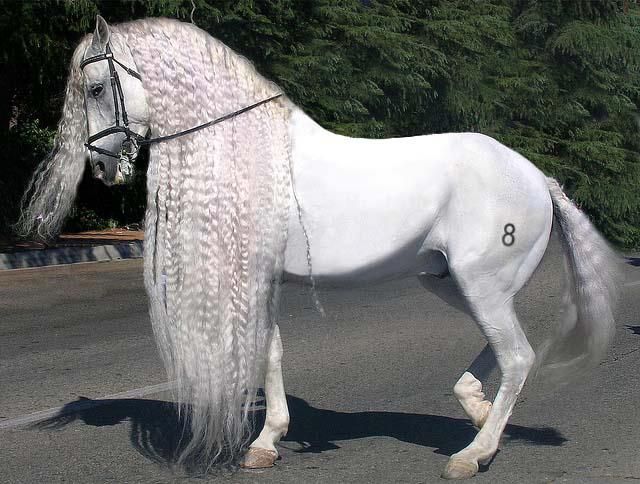
Andalusian
horses are attractive, flamboyant and extremely agile. Developed in Spain, in a region called
Andalusia, they are descended from the Iberian horses of Spain and
Portugal.
History
In
the 15th century Carthusian monks developed the breed, working hard to ensure
the Andalusian's purity and survival by
careful selective breeding. They refused
to use European blood as ordered by a Royal Edict and hid their horses from
Napolean's armies.
They
were popular as royal mounts and for haute ecole and have had a significant
effect on the development of many European breeds. Also, popular mounts for bullfighting and as
war horses, the Andalusian horses were
used as gifts to develop relations with other European countries.
The
introduction of the Thoroughbred
replaced the Andalusian in many ways and their popularity fell. In the 19th century the numbers began to drop
due to cross breeding, disease and war .
More
recently their numbers have again increased and in the 1960's the breed began
to be exported. Andalusian blood was then
used to develop many of the European warmbloods.
Characteristics
Height: 15hh - 15.2hh
Colour: Usually grey , occasionally other colours.
Conformation: The head is handsome with a straight profile
and broad forehead. Eyes are large and
the neck elegant. They have long,
sloping shoulders and well defined withers.
The body is short and strong and the chest broad. The tail is set low and thick, as is the
mane.
Temperament:
Easy to handle, intelligent and docile.
Used
for bullfighting in Spain, haute ecole, dressage, showjumping and driving.
Have you seen last week's video 'One Rainy Day in March!' on my You Tube channel?
Horse Life and Love. Please check it out and
You can also follow me on Facebook and
Instagram for updates on Chesney, Basil, Tommy and Daisy.
Until next time!
Jo
What
is it
Cushing's
Disease or PPID (Pituitary Pars Intermedia Dysfunction) is a relatively common
problem in older horses and ponies.
Research is ongoing into this endocrine
condition but if identified and treated many horses and ponies continue active
and healthy lives.
Signs
- Recurring laminitis
- Abnormal hair (hirsutism) - coat can be long and curly or a
simple change to shedding/moulting
Possible:
- Excessive sweating
- Increased appetite
- Increased drinking and urination
- Weight loss
- Lethargy
- Ulcers in mouth
- Poor performance
- Reduced immune function - resulting in recurring skin,
respiratory infections or foot abscesses, dental disease and increased
susceptibility to worms
- Loss of muscle condition
- Pot belly and/or fat deposits along mane
- Fat deposit over eye (where a depression is usually present)
Causes
As
they get older some horses produce insufficient amounts of Dopamine ( a
neurotransmitter). This neurotransmitter
controls the secretions from the Pituitary gland which in turn control the
secretion of cortisol and ACTH (hormones).
If the neurotransmitter is not produced sufficiently cortisol and ACTH
production is not controlled - the excess amounts then produced are what cause
the signs listed above.
Another
cause could be enlargement of the Pituitary gland, again resulting in changes
to hormone levels. Alternatively, a
tumour on the Pituitary gland will affect its ability to operate as
normal. It is thought that a large
percentage (perhaps 80%) of horses who suffer from laminitis may also be
suffering from Cushing's disease.
Diagnosis
Early
diagnosis and treatment gives the best chance for the treatment to give the
best results. Initial stages are gradual. Blood tests are available but are not
conclusive.
Treatment
Conditions
(eg: laminitis) should be treated. A
medicine is now available which can help to control the levels of hormones
produced which in turn controls the signs mentioned above!
Prevention
None
known at present but research is ongoing.
This
site is useful for more detailed information:
http://www.thelaminitissite.org/ppid.html
Have you seen this week's video 'One Rainy Day ... in March' on my You Tube channel?
Horse Life and
Love. Please check it out and SUBSCRIBE.
You can also follow me on Facebook, Instagram
and Twitter for updates on Chesney, Basil, Tommy and Daisy.
Until next time!
Jo
A very cheeky Tommy ...
Basil's flashy new rug ...
Chesney's spring overhaul is starting ...
Have you seen this week's video 'One Rainy Day ... in March' on my You Tube channel?
Horse Life and Love. Please check it out and SUBSCRIBE.
You can also follow me on Facebook, Twitter and
Instagram for updates on Chesney, Basil, Tommy and Daisy.
Until next time!
Jo